
Most e-invoicing commentary focuses on the obligations the Electronic Invoicing System creates. This article is about an obligation it may help resolve — one that has existed in UAE law since 2023, that has been operationally challenging to execute at scale, and that the Electronic Invoicing System may provide a practical way of operationalising.
The obligation is the domestic reverse charge self-invoice. Reading the domestic reverse charge provisions together with the VAT Law's invoicing framework raises an important implementation question: does the recipient of qualifying goods bear responsibility not just for accounting for the output tax, but for ensuring the associated invoicing obligation is also fulfilled? If that reading is correct, the Electronic Invoicing System — specifically, how the Accredited Service Provider is configured — offers a potential mechanism through which that obligation could be discharged automatically, at the volume and consistency that manual processes have rarely achieved.
That intersection of legal framework and enterprise architecture is what this article explores.
Key Takeaways
- The domestic reverse charge framework may give rise to a recipient self-invoice obligation.
- The interaction between the VAT Law and the Electronic Invoicing System creates important implementation considerations for businesses.
- Accredited Service Providers may be able to automate this obligation without significant ERP redesign.
- Businesses should evaluate this capability as part of their e-invoicing implementation planning and continue to monitor future guidance.
A Compliance Question That Predates E-Invoicing
Cabinet Resolution No. 91 of 2023 introduced the domestic reverse charge on electronic devices — mobile phones, computers, tablets, and their components — for B2B supplies between UAE VAT registrants where the recipient intends to resell or use the goods in manufacturing. Cabinet Resolution No. 127 of 2024 extended the same mechanism to precious metals and stones, effective February 2025.
What the Legislation Says
The domestic reverse charge transfers the VAT accounting obligation to the recipient. The supplier invoices at zero VAT. The recipient calculates and accounts for the output tax.
Cabinet Resolution 91/2023 is explicit that the recipient bears "all the tax liabilities arising from such supply." Article 65 of the Federal Decree-Law on VAT separately requires a registrant making a taxable supply to issue an original tax invoice.
A Possible Interpretation
Reading those provisions together, where responsibility for the VAT liability shifts to the recipient, the invoicing obligation may follow. The phrase "all the tax liabilities arising from such supply" may not, on its face, distinguish between the accounting obligation and the documentation obligation.
Taken together, these provisions support the view that the recipient bears responsibility for ensuring the associated invoicing obligation is fulfilled, in the form of a self-issued tax invoice.
Why the 2025 Amendment Strengthens This Interpretation
Federal Decree-Law No. 16 of 2025 amended the import reverse charge provision — Article 48(1) — to expressly state that the importer is responsible for accounting for the due tax, "with the exception of issuing a Tax Invoice to himself."
The amendment expressly introduces a specific carve-out, and it does so only within the import reverse charge. That carve-out does not exist in Article 48(8), the provision that empowers the Cabinet to designate goods for domestic reverse charge treatment. It does not appear in Cabinet Resolution 91/2023. It does not appear in Cabinet Resolution 127/2024.
The asymmetry between these two provisions may be read as reflecting a legislative distinction: the import reverse charge recipient has been expressly relieved of the self-invoice obligation; the domestic reverse charge recipient has not. The 2025 amendment strengthens the domestic reverse charge self-invoice interpretation — and in doing so, raises the practical stakes of addressing this question before January 2027.
The Operational Challenge
Before examining how the e-invoicing infrastructure responds to this question, it is worth understanding why execution has been difficult.
A distributor of electronic devices may receive dozens or hundreds of qualifying purchases in a single day. Under the domestic reverse charge, each of those transactions in principle requires the recipient to generate a separate, legally compliant tax invoice — with all the required particulars, a sequential invoice number, correct tax treatment, and retention for five years.
That is a significant administrative responsibility on transactions whose self-invoice exists primarily to satisfy a statutory documentation requirement rather than to record a commercial exchange between parties. Unlike a supplier invoice, the domestic reverse charge self-invoice serves no commercial function.
Operational approaches to this obligation have varied considerably across businesses. Each of these approaches presents different questions when considered against the legislative framework — whether periodic rather than transaction-level self-invoicing is sufficient, whether reliance on the supplier's invoice as a de facto equivalent is supportable under the domestic regime (a position with limited published support compared to the import reverse charge position under VATP044), and whether the absence of a self-invoice altogether is a risk that has been consciously assessed.
Practical Implementation Considerations: The Full Tax Invoice Requirement
For businesses within the UAE Electronic Invoicing System, domestic reverse charge transactions are B2B transactions requiring full tax invoices. At high transaction volumes, generating a separate full mirrored AR tax invoice for every qualifying AP purchase within the ERP could introduce significant operational complexity. This is precisely where the ASP architecture may provide a more scalable implementation approach.
Domestic reverse charge supplies are B2B transactions between VAT-registered businesses. Once a business falls within the Electronic Invoicing System, these transactions require full tax invoices — not simplified invoices. Each transaction requires the complete data set that a full PINT-AE e-invoice demands.
For many organisations, meeting that requirement under the pre-e-invoicing regime would have required complex ERP enhancements. At the volumes that qualifying businesses operate, that is the context in which the ASP model becomes architecturally interesting.
Where the Electronic Invoicing System Changes the Equation
The domestic reverse charge self-invoice obligation has existed in UAE law since 2023. What the Electronic Invoicing System changes is the practicality of fulfilling that obligation consistently at enterprise scale.
Rather than requiring another layer of ERP customisation — configuring the system to detect qualifying inbound purchases, generate a mirroring output document, assign sequential numbering, and populate all required VAT particulars — the obligation could potentially be discharged within the e-invoicing infrastructure itself.
The ERP continues to record the commercial transaction. The ASP orchestrates the additional compliance document required by the Electronic Invoicing System. This separates commercial transaction processing from compliance document orchestration. In practice, this also allows the ERP to remain focused on recording commercial events, while the e-invoicing layer manages regulatory documentation requirements that have no commercial implication. The audit trail is machine-readable and platform-verified.
How the ASP Workflow Operates in Practice
The workflow described below represents one potential implementation approach based on the current legislative and technical framework. Alternative implementation models may emerge as further guidance becomes available.
An Accredited Service Provider sits at the centre of every qualifying e-invoice flow. Every inbound domestic reverse charge purchase — where the supplier is correctly issuing PINT-AE invoices — passes through the recipient's ASP. That positioning, already inside the invoice workflow, is where the self-invoice can potentially be generated automatically.
The mechanism can operate in two stages.
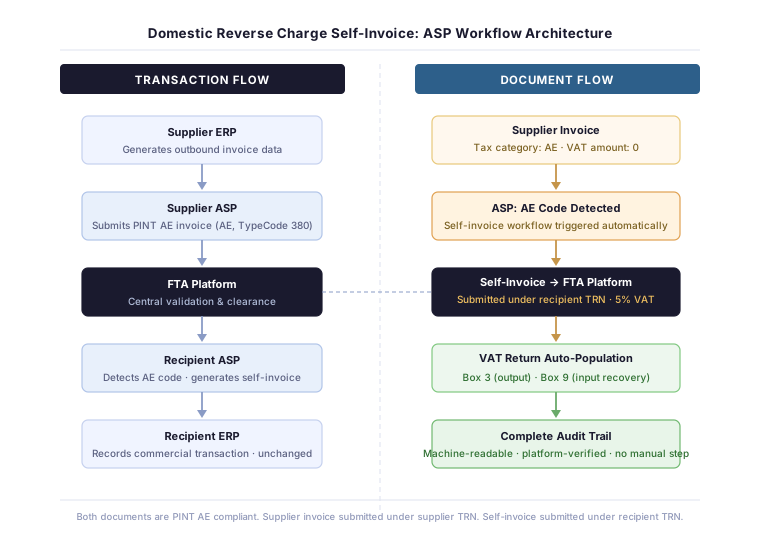
Stage 1 — The supplier's invoice. The supplier issues a PINT-AE e-invoice coded as a reverse charge supply: tax category specified, document type 380, zero VAT amount. The supplier's ASP submits this to the FTA platform under the supplier's TRN. The recipient receives the document through the platform.
Stage 2 — The self-invoice. The recipient's ASP detects the inbound invoice. Drawing on the supply particulars — counterparty details, date, description, consideration, currency — the ASP generates a self-invoice in the recipient's name, recording the output tax liability at 5%.
The result is two platform records for a single supply: the supplier's zero-VAT invoice documenting the commercial transaction, and the recipient's self-invoice documenting the tax liability. The recipient's VAT return draws its Box 3 output figure from the self-invoice and Box 9 input recovery figure from the supplier invoice data. The audit trail is complete and machine-readable without manual intervention.
Current Published Guidance and Implementation Considerations
The MOF UAE E-Invoicing Guidelines V1.1 (June 2026) addresses self-billing under Article 65(2) — the bilateral commercial arrangement where the recipient acts as agent for the supplier. The UAE MOF FAQs clarify that the self-billing scenario refers to the scenario where the buyer is authorised by the seller to issue the invoice, not the reverse charge mechanism. The self-billing use case may therefore not be the answer to the domestic reverse charge scenario.
The MOF FAQs address the domestic reverse charge separately, stating that in case of domestic reverse charge, both the supplier's invoice and the buyer's invoice will be sent through the e-invoicing network.
Businesses may therefore wish to seek clarification from the FTA — or to work through an ASP that has engaged the FTA directly on this question — before finalising platform configuration.
The Compliance Exposure Worth Understanding
Article 76(4) of the VAT Law provides for administrative penalties for failure to issue a tax invoice within the legally prescribed period. If the domestic reverse charge self-invoice interpretation outlined in this article is correct, the recipient who has not issued a self-invoice may fall within the scope of that provision. The penalty would fall on the recipient, since it is the recipient who bears the tax liabilities.
What Businesses Should Consider Before January 2027
Map domestic RC transaction volumes. Identify all purchases of electronic devices and precious metals that qualify for the domestic reverse charge. Quantify frequency, supplier count, and daily volumes. This is the population of transactions for which the self-invoice question arises in an e-invoicing context.
Review pre-supply documentation. Confirm that written declarations are in place for all domestic RC suppliers, obtained before the date of supply, and that TRN verification is documented and retained. If any of the pre-supply conditions are unmet, the domestic reverse charge does not apply — the supplier must charge standard-rate VAT, and input tax recovery may be affected under Article 2(4) of Cabinet Resolution 91/2023.
Include domestic RC self-invoicing in ASP requirements. Consider specifying the ability to detect inbound invoices and generate, transmit, and store self-invoices under the recipient's TRN as a functional requirement in any ASP selection or renewal process. Useful questions to ask a prospective ASP may include: Can your platform detect inbound invoices and trigger a self-invoice workflow automatically? Can the self-invoice be generated and submitted without manual intervention? Have you engaged the FTA on the correct PINT-AE document structure for this use case?
Consider seeking FTA clarification on PINT-AE structure. Businesses preparing go-live configurations should consider obtaining implementation guidance — either directly from the FTA or through an ASP — before committing to a platform design.
A Broader Observation
What the current legislative framework does highlight, when read as a whole, is an important implementation consideration for businesses preparing for mandatory e-invoicing: the ASP is not simply a document transmission channel. Properly configured, it can form an important component of the enterprise's compliance architecture — translating legislative requirements into automated operational controls.
As implementation programmes accelerate towards January 2027, this is one architectural consideration that businesses, implementation partners, and Accredited Service Providers may all wish to examine closely.
Go-Live Checklist for Domestic RC Self-Invoicing
For Phase 1 mandated businesses that purchase qualifying goods under the domestic reverse charge, the following steps are worth completing before January 2027:
- Confirm domestic RC transaction volumes and the supplier base generating qualifying purchases
- Verify pre-supply declarations and TRN verification records are in place, accurately dated, and retained
- Assess whether the selected ASP can detect inbound invoices and generate self-invoices under the required TRN automatically
- Seek implementation guidance on PINT-AE document structure for domestic RC self-invoices — from the FTA directly, or through an ASP
- Test the end-to-end workflow: inbound invoice detection → self-invoice generation → platform submission under recipient TRN
Legislative references: Federal Decree-Law No. 8 of 2017 (as amended by FDL 18/2022, FDL 16/2024, and FDL 16/2025); Cabinet Decision No. 52 of 2017 (Executive Regulation); Cabinet Resolution No. 91 of 2023; Cabinet Resolution No. 127 of 2024; VATP044; Ministerial Decision No. 243 of 2025; Ministerial Decision No. 244 of 2025; Ministerial Resolution No. 56 of 2026; MOF UAE E-Invoicing Guidelines V1.1 (June 2026); PINT-AE Specification (May 2026).
Author's note: The views expressed in this article are those of the author and are intended to encourage discussion around enterprise implementation considerations based on the current legislative and published implementation framework. They should not be regarded as tax, technical or legal advice or as representing the views of the Ministry or the Tax Authority, or any other organisation. Businesses should consider their own circumstances and monitor future guidance issued by the relevant authorities.